Avoid Common Pitfalls in MOE Syllabus Alignment

Understanding MOE Syllabus Requirements

Imagine a bustling kitchen where every chef knows exactly how to prepare each dish to perfection. This is similar to the role of the MOE syllabus in Singapore's education system—it provides a precise recipe for academic success. For parents seeking online tuition for their children, understanding and aligning with the MOE syllabus is crucial to ensuring that their child is not only prepared for exams but also equipped with the skills and knowledge that meet national education standards.

Why Alignment with the MOE Syllabus Matters

In the competitive landscape of Singapore's education system, the MOE syllabus serves as a benchmark for quality and relevance. It is meticulously designed to cover essential topics at each educational level, ensuring students acquire a strong foundation in mathematics. But why is this alignment so critical?

    Parents seeking detailed information on Singapore's educational curriculum and standards can visit the MOE singapore website for comprehensive resources..
  • Consistency and Structure: Just as a well-organized library makes it easier to find the right book, the MOE syllabus provides a structured framework that guides both teaching and learning processes. This consistency ensures that all students, regardless of their learning environment, receive a comprehensive education.
  • Exam Preparedness: Aligning with the MOE syllabus guarantees that students are well-prepared for national exams like the PSLE, O-Levels, and A-Levels. Tutors who adhere to this syllabus can tailor their lessons to focus on key areas that are frequently tested, giving students an edge in their exam preparation.
  • Quality Assurance: By following the MOE syllabus, online tuition providers like Odyssey Math Tuition can assure parents of the quality and relevance of their curriculum, fostering trust and confidence in their services.
  • Fun Fact: The MOE syllabus undergoes regular reviews to ensure it stays relevant and effective in meeting the evolving educational needs of students in Singapore.

Common Pitfalls in Syllabus Alignment and How to Avoid Them

While aligning with the MOE syllabus is essential, it’s not without its challenges. Picture a tightrope walker trying to balance—one misstep can lead to a fall. Here are some common pitfalls and strategies to avoid them:

Overemphasis on Rote Learning

One common mistake is focusing heavily on rote learning, where students memorize formulas and procedures without understanding underlying concepts. This is akin to knowing the ingredients of a recipe without understanding how they come together to create a dish. Effective online tuition should encourage critical thinking and problem-solving skills, helping students to understand the 'why' behind mathematical concepts.

Neglecting Individual Learning Needs

Every student is unique, much like snowflakes in a winter storm. A one-size-fits-all approach can hinder a student’s learning progress. Personalized instruction, a hallmark of quality online tuition, ensures that lessons are tailored to the individual strengths and weaknesses of each student, facilitating a deeper understanding and mastery of the subject.

Ignoring Technological Tools

In today’s digital age, ignoring the use of technological tools is like trying to navigate a city without a map. Interactive tools such as shared whiteboards, digital resources, and video platforms are integral to online tuition, making learning more engaging and effective. Tutors should leverage these technologies to enhance the learning experience, providing students with diverse ways to engage with the material.

Adapting to Different Educational Levels

Just as a gardener adjusts their care techniques for different plants, tutors must adapt their strategies to cater to various educational levels, from primary to junior college. Numerous families in Singapore are seeking out reliable online tuition platforms to assist their kids thrive in difficult areas like mathematics.. Each stage requires a unique approach:

  • Primary Level: Focus on foundational concepts such as fractions and model drawing. Engaging activities and visual aids can make abstract concepts more tangible for younger learners.
  • Secondary Level: Emphasize algebra, geometry, and trigonometry, incorporating real-world applications to demonstrate relevance and practicality.
  • Junior College Level: Dive into advanced topics like calculus and statistics, encouraging analytical thinking and independent learning skills.
  • Did You Know? Singapore consistently ranks among the top in international education assessments, thanks in part to its robust and comprehensive syllabus.

The Future of Online Tuition and MOE Syllabus Alignment

As we gaze into the future, the role of online tuition in Singapore is set to expand, driven by advancements in technology and evolving educational needs. Imagine a world where students can access personalized learning experiences from anywhere, at any time. The integration of artificial intelligence and data analytics could further personalize education, providing insights into each student's learning patterns and adapting the curriculum to suit their needs.

Parents and students can look forward to more interactive and dynamic learning environments, where the MOE syllabus serves as a reliable compass guiding their educational journey. By embracing these innovations, online tuition providers can continue to offer flexible, accessible, and effective support, helping students not only to excel academically but to develop a lifelong love for learning.

Understanding and aligning with the MOE syllabus is key to unlocking a student's full potential. By avoiding common pitfalls and adapting to the unique needs of each learner, online tuition can provide a powerful platform for academic success. So, as you embark on this educational journey with your child, remember that the right alignment is not just about meeting standards—it's about empowering students to reach for the stars.

Identifying Common Pitfalls

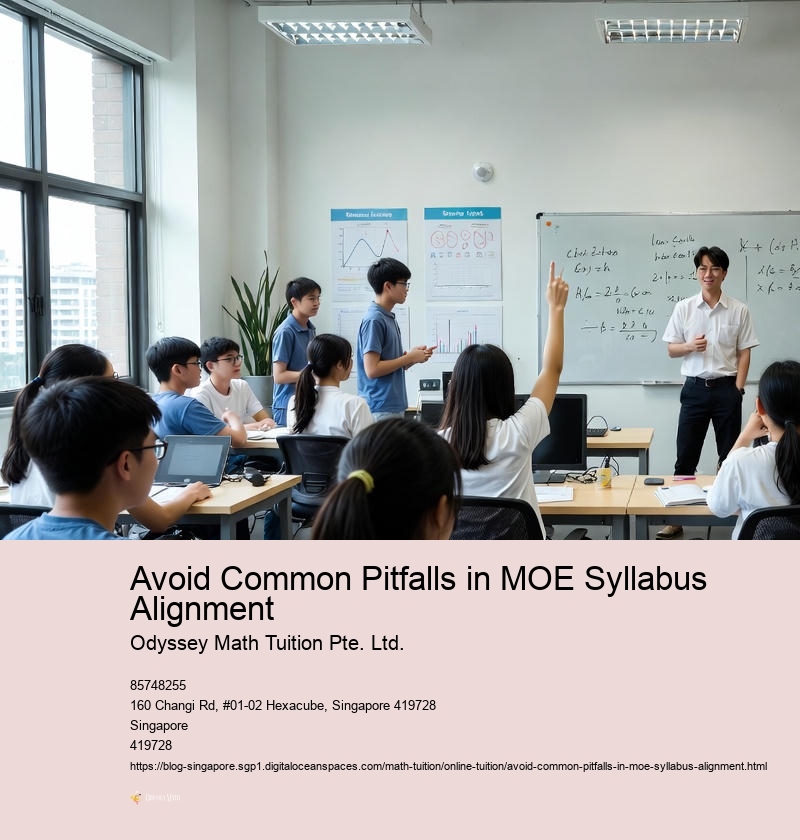
Imagine a bustling kitchen where chefs are meticulously preparing a grand feast. Each dish must not only look appealing but also meet the precise taste expectations of a discerning guest. Now, picture this kitchen as the world of education, the chefs as educators, and the feast as the curriculum—specifically, the MOE syllabus in Singapore. The challenge is to align every educational element, ensuring students receive a balanced and relevant learning experience. But what happens when the ingredients don't quite mix? This is where the common pitfalls in MOE syllabus alignment come into play.

Understanding the MOE Syllabus: The Recipe for Success

The Ministry of Education (MOE) syllabus serves as a national benchmark, ensuring that the curriculum delivered across schools meets high educational standards. Odyssey Math Tuition, for instance, emphasizes the importance of aligning with this syllabus to guarantee relevance and quality in their online tuition services. But what does this alignment truly entail?

Alignment with the MOE syllabus involves not just teaching the right content but also adopting the prescribed teaching methodologies and assessment strategies. It's like following a recipe where each step is crucial to achieving the desired outcome. However, even with a clear recipe, challenges can arise.

  • The MOE syllabus is designed to ensure consistency in educational quality across all schools in Singapore.
  • Regular updates to the syllabus reflect the evolving educational landscape and global trends.

The Common Pitfalls: When the Recipe Goes Awry

One of the primary challenges educators face is the misinterpretation of syllabus objectives. This can lead to a focus on rote learning rather than understanding. Imagine a math class where students are taught to memorize formulas without grasping the underlying concepts. This approach might help them pass exams but doesn't equip them with the problem-solving skills needed for real-world applications.

Another common pitfall is the lack of flexibility in teaching methods. In a world that's rapidly embracing digital transformation, sticking to traditional chalk-and-board methods can leave students disengaged. Online tuition platforms offer interactive tools, such as shared whiteboards and digital resources, which can make learning more engaging and effective. However, not all educators are quick to adapt, resulting in missed opportunities for enhanced learning experiences.

  • Studies show that interactive learning can significantly improve student engagement and retention.

Innovations in Online Tuition: Stirring the Pot

Online tuition has revolutionized the way students engage with the MOE syllabus. By offering flexibility and accessibility, it caters to the needs of busy students preparing for crucial exams like the PSLE, O-Levels, or A-Levels. Platforms that incorporate video calling technologies, such as Zoom or Skype, allow students to learn from anywhere, breaking geographical barriers.

Moreover, the integration of e-learning resources, including pre-recorded videos and interactive modules, provides students with the autonomy to learn at their own pace. This approach not only supports syllabus alignment but also fosters a deeper understanding of mathematical concepts.

  • Online learning platforms have seen a significant increase in adoption, especially during the global pandemic.

Strategies for Seamless Alignment: A Dash of Innovation

To avoid the pitfalls of misalignment, educators can adopt several strategies. First, continuous professional development is key. By staying updated with the latest educational trends and technologies, educators can adapt their teaching methods to better align with the MOE syllabus. This is akin to chefs attending culinary workshops to refine their skills and learn new techniques.

Secondly, fostering open communication between educators and parents can enhance the learning experience. By understanding the challenges students face, educators can tailor their approaches to meet individual needs. This collaborative effort ensures that the educational 'dish' is both palatable and nourishing.

  • Professional development programs for educators have been shown to improve teaching effectiveness and student outcomes.

The Future of Education: A Call to Action

As we look towards the future, the role of online tuition in syllabus alignment becomes ever more critical. What if every student had access to personalized learning experiences that not only prepared them for exams but also instilled a lifelong love for learning? This vision can become a reality with the continued evolution of online education platforms, supported by innovative teaching practices and robust syllabus alignment.

For parents seeking the best for their children, investing in online tuition services that prioritize MOE syllabus alignment is a step in the right direction. By embracing these modern educational tools, we can ensure that students are not just prepared for exams but are also equipped to thrive in an ever-changing world.

Strategies for PSLE Math Alignment

Syllabus Coverage

Ensuring comprehensive syllabus coverage is crucial for effective PSLE math preparation. The Ministry of Education (MOE) sets specific guidelines that outline the topics and skills students need to master. Tutors must familiarize themselves with these guidelines to provide tailored and focused instruction. By doing so, they can ensure that students are not only meeting the required standards but also gaining confidence in their mathematical abilities. This approach helps prevent gaps in knowledge that could impact exam performance. Parents can be reassured that their children are receiving instruction aligned with national expectations, preparing them for success.

  • The PSLE math syllabus includes topics such as numbers, measurements, geometry, data analysis, and algebra.
  • Regular updates to the syllabus ensure that it remains relevant to current educational standards and practices.

Conceptual Understanding

Developing a deep conceptual understanding of math topics is essential for students to excel in the PSLE. Rather than relying solely on rote memorization, tutors should focus on helping students grasp the underlying principles of mathematical concepts. This can be achieved through the use of real-world examples, interactive tools, and engaging problem-solving activities. When students understand the 'why' behind mathematical operations, they become more adept at applying their knowledge to novel problems. This strategy not only enhances learning but also fosters a genuine interest in mathematics.

  • Research shows that students who understand concepts deeply are more likely to retain information and apply it effectively.

Interactive Tools

Incorporating interactive tools into online tuition can significantly enhance the learning experience for students. Platforms like Zoom or Skype offer features such as shared whiteboards and chat functions, which encourage active participation and engagement. These tools allow tutors to illustrate complex concepts visually and facilitate real-time feedback. Additionally, digital resources such as e-learning modules and pre-recorded lessons provide students with the flexibility to review material at their own pace. By utilizing these technologies, tutors can create a dynamic and supportive learning environment that caters to individual student needs.

  • Studies have shown that interactive learning can improve student engagement and understanding by up to 30%.
  • Fun Fact: The first interactive whiteboard was introduced in the early 1990s and has since revolutionized classroom teaching.

Exam Strategies

Equipping students with effective exam strategies is a vital component of PSLE preparation. Tutors should teach techniques such as time management, question analysis, and methodical problem-solving to help students navigate the exam confidently. Practice exams and mock tests can simulate the exam environment, allowing students to refine these strategies under pressure. Understanding the format and expectations of the PSLE can reduce anxiety and improve performance. By mastering these strategies, students are more likely to approach the exam with a calm and focused mindset, optimizing their chances for success.

  • On average, students who practice with mock exams perform better due to increased familiarity with the exam format.

Parental Involvement

Parental involvement plays a key role in a child's success in math education. Parents can support their children's learning by creating a conducive study environment and encouraging consistent practice. Communicating regularly with tutors helps parents stay informed about their child's progress and areas needing improvement. This partnership between parents and tutors ensures that learning is reinforced both at home and during tuition sessions. Additionally, parents can motivate their children by celebrating achievements and fostering a positive attitude towards math. Their engagement is instrumental in building a supportive framework for academic excellence.

  • Fun Fact: Studies have shown that children whose parents are actively involved in their education tend to have higher academic achievement.

Addressing Secondary Math Challenges

Imagine a bustling classroom where each student is a budding mathematician, navigating the intricate world of algebra and geometry with curiosity and determination. Now picture these young learners equipped with the right tools and guidance, tackling mathematical challenges with confidence. This is the vision behind aligning secondary math education with the Ministry of Education (MOE) syllabus in Singapore, a crucial step for students preparing for pivotal exams like the O-Levels.

Understanding the MOE Syllabus

Why is alignment with the MOE syllabus so essential? The MOE syllabus sets the national standards for education in Singapore, ensuring that all students receive a consistent and high-quality education. By aligning content with these standards, educators can guarantee that their teaching is relevant, comprehensive, and effective. This alignment is especially crucial for secondary students, who face the dual challenge of mastering both Elementary Math (E-Math) and Additional Math (A-Math).

  • The MOE syllabus is regularly updated to incorporate the latest educational research and methodologies, ensuring students are prepared for future challenges.

Tailoring Content for E-Math and A-Math

Secondary school students in Singapore encounter a broad spectrum of mathematical concepts, from the foundational principles of E-Math to the more complex theories in A-Math. Each stream requires a unique approach. E-Math focuses on practical applications of mathematics in everyday life, covering topics like statistics and basic algebra. In contrast, A-Math delves deeper into abstract concepts such as calculus and trigonometry.

To effectively tailor content for these subjects, online tuition providers must employ innovative strategies. Interactive digital tools, such as shared whiteboards and dynamic simulations, can transform complex equations into visual experiences, making learning both engaging and effective.

  • Fun Fact: The concept of zero, a fundamental element in mathematics, was developed by ancient Indian mathematicians and later transmitted to the Islamic world and Europe.

The Role of Online Tuition

In today's digital age, online tuition has emerged as a powerful tool to support students' learning journeys. Imagine a virtual classroom where students can connect with expert tutors from the comfort of their homes, accessing personalized instruction tailored to their individual needs. This format offers unparalleled flexibility and convenience, allowing students to learn at their own pace while balancing other commitments.

Online tuition platforms often provide a wealth of resources, including pre-recorded videos, past exam questions, and structured e-learning courses. These resources empower students to deepen their understanding and excel in exams, all while aligning with the MOE syllabus.

  • News: Recent studies have shown that students who engage in online learning can achieve similar or even better outcomes compared to traditional classroom settings.

Overcoming Common Pitfalls

Despite the advantages of online tuition, several common pitfalls can hinder students' progress. One major challenge is ensuring that the content aligns closely with the MOE syllabus. Providers like Odyssey Math Tuition prioritize this alignment, guaranteeing that their curriculum is both relevant and rigorous.

Another hurdle is maintaining student engagement in a virtual setting. Creative teaching methods, such as storytelling and real-world applications, can help capture students' interest and make abstract concepts more relatable. For instance, exploring the geometry of a honeycomb can transform a math lesson into a fascinating exploration of nature's efficiency.

Looking Ahead: The Future of Math Education

As technology continues to evolve, the future of math education in Singapore looks promising. Imagine a world where artificial intelligence and machine learning provide personalized feedback, guiding students through their unique learning paths. This future is not far off, and it holds exciting possibilities for enhancing educational outcomes.

With the right tools and strategies, secondary students can navigate the complexities of math with ease, supported by a robust framework aligned with the MOE syllabus. As parents and educators, we have the opportunity to shape a brighter future for our young mathematicians, equipping them with the skills they need to thrive in a competitive world.

  • Fun Fact: The Fibonacci sequence, a series of numbers where each number is the sum of the two preceding ones, appears frequently in nature, such as in the arrangement of leaves on a stem.

Tailoring Content for Junior College Students

Imagine a world where every Junior College student in Singapore feels confident walking into their A-Level mathematics exams. This is not just a dream but a tangible goal that online tuition can help achieve. With the competitive nature of Singapore's education system, aligning tuition content with the Ministry of Education (MOE) syllabus is crucial for success, especially for students taking H1, H2, and H3 Mathematics. But what does alignment truly mean, and how can it be achieved without falling into common pitfalls?

Understanding the MOE Syllabus: A Map for Success

Think of the MOE syllabus as a treasure map. It guides students through the vast ocean of mathematical concepts, ensuring they reach the treasure—mastery of the subject and excellent exam results. Odyssey Math Tuition, for example, emphasizes that alignment with the MOE syllabus guarantees relevance and quality, ensuring that students are not just learning but mastering the right content.

  • The MOE syllabus is regularly updated to reflect the latest educational standards and practices, ensuring students receive a contemporary education.

Interactive Learning: The Digital Classroom

Online tuition has transformed the traditional classroom into a dynamic digital space. Using platforms like Zoom or Skype, students can engage with math concepts interactively, utilizing tools like shared whiteboards and digital resources. This format not only mirrors traditional home tuition but offers added flexibility and accessibility. Imagine a student solving a calculus problem with a digital pen, instantly receiving feedback from a tutor halfway across the city. This is the new age of learning.

  • According to a study by the Singapore Management University, interactive learning can enhance student engagement and improve retention rates by up to 25%.

Common Pitfalls in Syllabus Alignment and How to Avoid Them

While aligning with the MOE syllabus is essential, it's easy to stumble into common traps. One such pitfall is overloading students with information. It's like trying to drink from a firehose—overwhelming and ineffective. Instead, breaking down complex topics into manageable chunks keeps students engaged and prevents burnout.

  • Research from the National Institute of Education suggests that students perform better when lessons are segmented into focused, shorter sessions.

The Power of Customization

Customization is key. Every student is a unique puzzle, and online tuition offers the flexibility to tailor lessons to individual needs. Whether it's focusing on algebra for one student or diving deep into trigonometry for another, personalized tuition ensures that no one is left behind. This approach is akin to crafting a bespoke suit—perfectly fitted to the student's learning style and pace.

Embracing Technology: The Future of Learning

Technology is the unsung hero in the journey of aligning tuition with the MOE syllabus. E-learning resources, such as pre-recorded videos and self-paced programs, provide students with the opportunity to learn on their own terms. It's like having a personal tutor available 24/7, ready to explain complex functions or guide through challenging statistics problems whenever needed.

  • A report by the World Economic Forum highlights that technology in education can increase learning outcomes by up to 30% when used effectively.

What If: The Future of Math Tuition in Singapore

What if we could predict the future of math tuition in Singapore? With the rapid advancement of technology and the increasing demand for flexible learning solutions, the potential is limitless. Imagine a world where AI tutors adapt lessons in real-time, or virtual reality immerses students in a 3D mathematical universe. The possibilities are as vast as the universe itself.

Aligning online tuition with the MOE syllabus is not just about meeting standards; it's about setting students up for success in a competitive educational landscape. By avoiding common pitfalls and embracing technology, parents and students can navigate the sea of mathematical concepts with confidence and precision. So, the next time you think about online tuition, remember—it's not just about learning math; it's about mastering it for the future.

Integrating International Curriculum Needs

Imagine being a young student in Singapore, navigating the intricate labyrinth of educational syllabi. You're not just learning math; you're embarking on a journey through a world where numbers dance and equations sing. But what if this journey could be enriched by integrating elements from international curricula like IGCSE and IB into the Ministry of Education (MOE) syllabus? This is the magical realm where online tuition steps in, offering a bridge between diverse educational needs and the rigorous standards set by the MOE.

Aligning with the MOE Syllabus: The Cornerstone of Success

In Singapore, the MOE syllabus serves as the gold standard for educational excellence. It's a carefully crafted blueprint ensuring that students receive a holistic and relevant education. Aligning with this syllabus means that students are not only prepared for national examinations but also equipped with skills that transcend the classroom. Odyssey Math Tuition, for instance, offers a curriculum meticulously aligned with the MOE standards, guaranteeing that students receive quality instruction that meets national expectations.

  • The MOE syllabus is regularly updated to reflect global educational trends and local needs.
  • Singapore consistently ranks high in international education assessments, such as PISA, due to its robust curriculum.

Blending IGCSE and IB Elements: A Global Perspective

While the MOE syllabus is robust, incorporating elements from international curricula like IGCSE and IB can offer students a broader perspective. These systems emphasize critical thinking, problem-solving, and a global outlook, which are invaluable in today's interconnected world. By blending these elements with the MOE syllabus, online tuition platforms create a dynamic learning environment that caters to students from diverse backgrounds, preparing them for both local and international challenges.

  • The IGCSE is recognized by universities and employers worldwide, providing students with a competitive edge.
  • IB programs are known for fostering independent learning and encouraging students to explore subjects in depth.

The Role of Online Tuition in Syllabus Integration

Online tuition has revolutionized the way students learn in Singapore. With platforms offering interactive tools such as shared whiteboards and digital resources, students can engage with complex math concepts in a personalized setting. This format is not just about convenience; it's about enhancing the educational experience. By integrating IGCSE and IB elements, online tuition provides a rich tapestry of learning opportunities, ensuring students are well-prepared for exams like the PSLE, O-Levels, and A-Levels.

  • Online tuition offers flexibility, allowing students to learn at their own pace and revisit recorded sessions as needed.
  • Interactive tools in online tuition can increase student engagement and motivation.

Overcoming Common Pitfalls: A Guide for Parents

For parents navigating this educational landscape, understanding the nuances of syllabus alignment can be daunting. However, by choosing online tuition services that prioritize MOE alignment while incorporating international elements, they can ensure their children receive a comprehensive education. Look for tutors and platforms that offer recorded sessions, e-learning resources, and flexible schedules to accommodate busy family lives. These features are not just perks; they are essential tools in the modern educational toolkit.

  • Parents can monitor their child's progress through online platforms, providing insights into their learning journey.

A Future of Endless Possibilities

As we look to the future, the integration of international curricula with the MOE syllabus holds promise for a new era of education in Singapore. It's a world where students are not confined by borders but are instead inspired by a global community of learners. What if every student had the opportunity to explore math through the lens of different cultures and educational philosophies? This is the exciting potential that online tuition unlocks—a future where learning is as limitless as a starry sky.

Utilizing Online Tools Effectively

Imagine a world where learning mathematics feels like embarking on an exciting adventure. For Singaporean parents, navigating their children's educational journey can sometimes feel like solving a complex puzzle. But what if there was a way to make this journey smoother, more engaging, and aligned with national standards? Enter the realm of online tuition, a revolutionary approach that blends the convenience of digital tools with the rigour of the Ministry of Education (MOE) syllabus.

Embracing the Digital Classroom

In the bustling city-state of Singapore, education is a top priority, and mathematics is at the core of this academic pursuit. With the rise of online tuition, students now have the opportunity to learn from the comfort of their homes. Platforms like Zoom and Skype transform living rooms into classrooms, where students tackle math problems with the guidance of experienced tutors. These virtual sessions are not just about convenience—they're about creating a personalized learning experience that caters to each student's unique needs.

  • Singapore consistently ranks among the top in global education assessments, highlighting the importance of innovative learning methods.

Why Aligning with the MOE Syllabus Matters

Imagine trying to build a house without a blueprint. It would be chaotic, right? Similarly, aligning with the MOE syllabus ensures that students are building their mathematical knowledge on a solid foundation. This alignment guarantees that the curriculum meets national education standards, much like how Odyssey Math Tuition integrates these standards to ensure relevance and quality. By following this roadmap, students are better prepared for national exams like the PSLE, O-Levels, and A-Levels.

  • The MOE syllabus is designed to develop critical thinking and problem-solving skills, essential for future success.

The Power of E-Learning Platforms

Online tuition isn't just about live sessions. It's a comprehensive ecosystem of digital resources. Think of it as a treasure trove of pre-recorded videos, interactive diagrams, and structured self-paced programs. These resources allow students to revisit challenging concepts, practice at their own pace, and strengthen their understanding. The flexibility of e-learning platforms is akin to having a personal math assistant available 24/7, ready to help whenever needed.

  • Studies show that students who use e-learning platforms often perform better due to the ability to review materials multiple times.

Interactive Tools: The Game Changer

Picture a shared whiteboard, where students and tutors collaborate in real-time to solve complex equations. This is the magic of interactive tools in online tuition. These digital aids transform abstract concepts into tangible experiences. It's like turning math into a game, where students can experiment, make mistakes, and learn in a supportive environment. The engagement these tools provide is unmatched, making learning not just effective but also enjoyable.

  • Interactive learning tools have been shown to increase student engagement by up to 30% compared to traditional methods.

Overcoming Challenges in Online Tuition

While online tuition offers numerous benefits, it's not without its challenges. Ensuring a stable internet connection and a distraction-free environment can sometimes be tricky. However, with the right setup and mindset, these hurdles can be overcome. Parents play a crucial role here, acting as facilitators to create an optimal learning space for their children.

A Glimpse into the Future

What does the future hold for online tuition in Singapore? As technology continues to evolve, we can anticipate even more innovative tools that will further enhance the learning experience. Virtual reality classrooms, AI-driven personalized learning paths, and global collaborations are just a few possibilities on the horizon. The goal remains the same: to provide accessible, flexible support that empowers students to excel in mathematics.

In this digital age, online tuition is more than just an alternative to traditional learning—it's a gateway to a world of possibilities. By embracing these tools and aligning with the MOE syllabus, parents and students can embark on a mathematical journey that's as rewarding as it is educational. So, why not take the leap and explore the endless opportunities that online tuition has to offer?

Role of Interactive Learning in Syllabus Alignment

Imagine a bustling Singaporean household where the aroma of freshly brewed kopi fills the air. Parents, eager to provide the best education for their children, gather around a laptop for an online math tuition session. It's a scene that has become increasingly common in the Lion City, where competitive education standards demand innovative learning solutions. But how can these sessions ensure they align with the Ministry of Education (MOE) syllabus, avoiding common pitfalls and maximizing educational outcomes?

Unveiling the Digital Classroom

The concept of online tuition in Singapore is akin to a digital bridge, connecting students with expert tutors without the constraints of physical location. This format, leveraging platforms like Zoom or Skype, mirrors traditional tuition but with added flexibility. Students can access interactive tools such as shared whiteboards and digital resources, enhancing personalized instruction.

Yet, the challenge lies in ensuring these sessions align seamlessly with the MOE syllabus. The syllabus, a cornerstone of Singapore’s education system, ensures that the curriculum meets national education standards. Aligning with it is not just about ticking boxes; it’s about guaranteeing relevance and quality, as emphasized by reputable tuition services like Odyssey Math Tuition.

Interactive Learning: The Game Changer

Interactive learning is the unsung hero of modern education. Picture it as a vibrant tapestry woven with threads of engagement, collaboration, and critical thinking. In the context of online tuition, it involves using digital tools to create a dynamic learning environment. But how exactly does this support syllabus alignment?

  • Shared Digital Tools: These tools allow students to visualize and manipulate math concepts in real-time, fostering a deeper understanding. For example, using a digital whiteboard to solve algebraic equations can transform abstract ideas into tangible solutions.
  • Live Sessions: Real-time interaction with tutors enables immediate feedback and clarification of doubts, ensuring that students are on the right track with their syllabus requirements.
  • Fun Fact: According to a study by the National Institute of Education, students engaged in interactive learning environments show improved problem-solving skills and increased motivation.

Overcoming Common Pitfalls

Despite the advantages, navigating the world of online tuition isn't without its challenges. A common pitfall is the temptation to stray from the MOE syllabus, focusing instead on trendy but irrelevant content. How can parents and tutors steer clear of this?

One effective strategy is to regularly review the syllabus and tailor lessons accordingly. Consider it a roadmap, guiding each session to ensure that every destination (or learning outcome) is met. Additionally, incorporating past exam questions can help students familiarize themselves with the exam format, building confidence and competence.

The Future of Online Tuition

As we peer into the future, the role of online tuition in Singapore's education landscape continues to evolve. With advancements in technology, the potential for more immersive and personalized learning experiences is vast. Imagine a world where virtual reality is part of the curriculum, allowing students to explore mathematical concepts in a 3D space.

Parents, too, play a crucial role in this evolution. By staying informed and actively participating in their children's learning journey, they can ensure that online tuition remains a valuable supplement to traditional education, perfectly aligned with the MOE syllabus.

A Call to Action

So, what if we embraced this digital revolution wholeheartedly, using it as a tool to not only meet but exceed educational standards? As parents and educators, the onus is on us to harness the full potential of online tuition, ensuring that it remains a beacon of quality education in Singapore.

Let’s embark on this journey together, weaving a tapestry of knowledge that not only prepares students for exams but also equips them with the skills to thrive in an ever-changing world.

Measuring Success in Alignment

Imagine a young student, seated at their desk, eyes fixed on a screen, as they embark on a journey of numbers and logic. This isn't a typical classroom; it's the digital realm of online tuition, where the boundaries of traditional education dissolve, offering a world of possibilities. But how do we ensure that this innovative learning aligns with the rigorous demands of Singapore's Ministry of Education (MOE) syllabus? Let's delve into this evolving landscape, uncovering the secrets to successfully navigating this educational voyage.

Setting Sail with MOE Syllabus Alignment

In the bustling world of Singapore's education, the MOE syllabus serves as the North Star, guiding students towards academic excellence. By aligning with this syllabus, platforms like Odyssey Math Tuition ensure that their curriculum not only meets national standards but also stays relevant and of high quality. For parents and students, this alignment is a promise of consistency and reliability, akin to a ship charting its course with a trusted map.

  • The MOE syllabus is updated regularly to incorporate global educational trends and ensure students are prepared for future challenges.

The Foundation: Understanding the MOE Syllabus

At its core, the MOE syllabus is a comprehensive framework designed to equip students with essential skills and knowledge. It's not just about solving equations; it's about nurturing critical thinking, problem-solving, and analytical skills. For primary school students, this might mean mastering fractions and model drawing. As they progress to secondary levels, the challenges evolve into algebra, geometry, and calculus, preparing them for O-Levels and beyond.

  • Fun Fact: Singapore consistently ranks among the top in international assessments like PISA, thanks in part to its rigorous syllabus.

Navigating the Digital Seas: The Role of Online Tuition

Online tuition emerges as a beacon of flexibility and convenience, especially for busy families. It mirrors traditional tutoring but with a digital twist, allowing students to learn from anywhere. Platforms offer interactive tools like shared whiteboards and digital resources, transforming the learning experience into a dynamic, engaging adventure.

Interactive Learning: A New Wave of Engagement

Imagine a classroom where lessons come alive with interactive diagrams and real-time problem-solving. Online tuition platforms harness technology to make learning more engaging. Students can tackle past exam questions, explore pre-recorded lessons, and even participate in live sessions, all tailored to their pace and understanding.

  • News: Recent studies have shown that interactive learning can improve student retention rates by up to 60%.

Overcoming Challenges: Avoiding Common Pitfalls

While the digital realm offers immense potential, it also presents unique challenges. Ensuring alignment with the MOE syllabus is crucial to avoid pitfalls. This involves regular updates to the curriculum, incorporating feedback from educators, and staying attuned to changes in educational standards. It's a bit like navigating a ship through uncharted waters, requiring vigilance and adaptability.

Adaptive Strategies: Steering Through Change

As the educational landscape evolves, so must our strategies. Online tuition providers must be proactive, continuously assessing student performance and adapting their approaches. This might involve introducing new e-learning resources or refining teaching methods to better suit diverse learning styles. The goal is to create a seamless learning journey that meets the unique needs of each student.

  • Adaptive learning technologies can personalize the educational experience, catering to individual student strengths and weaknesses.

Charting the Course for Future Success

As we look to the future, the potential of online tuition in Singapore is boundless. With ongoing advancements in technology and pedagogy, the possibilities for enhancing student learning are limitless. Parents and students can rest assured that, with the right alignment and strategies, the digital classroom can be as effective—and perhaps even more enriching—than traditional methods.

So, as we stand on the cusp of this educational revolution, we invite you to explore the vibrant world of online tuition. Whether your child is preparing for the PSLE, O-Levels, or A-Levels, the journey promises to be an exciting one, filled with opportunities for growth and discovery. Are you ready to set sail?

Continuous Improvement and Feedback

Imagine a bustling city where digital learning becomes the norm, a place where children from primary schools to junior colleges embark on a journey of mathematical discovery. In Singapore, the world of online tuition is a vibrant landscape, shaped by the need for flexibility and personalized instruction. But amidst this digital evolution, a question lingers: How can online tuition providers ensure their teaching methods remain aligned with the Ministry of Education (MOE) syllabus, continuously adapting to changes and updates?

Setting the Stage: The Importance of Syllabus Alignment

In the realm of online tuition, alignment with the MOE syllabus is akin to having a reliable GPS for a road trip. It ensures that the curriculum meets national education standards, guaranteeing relevance and quality. By aligning with the MOE syllabus, providers like Odyssey Math Tuition offer students a structured path to success, ensuring that every lesson is a step toward mastering the concepts needed for exams like the PSLE, O-Levels, or A-Levels.

  • Fun Fact: The MOE syllabus is regularly reviewed to keep up with global educational trends, ensuring that students receive a world-class education.

Feedback Loops: The Heartbeat of Continuous Improvement

In the dynamic world of online tuition, feedback loops are the heartbeat that keeps the system alive and thriving. Picture this: a virtual classroom buzzing with interaction, where students and tutors exchange insights like a lively marketplace of ideas. Through feedback, tutors gain valuable insights into the effectiveness of their teaching methods. This ongoing dialogue allows them to refine their approaches, ensuring that each session is not just a lesson, but a personalized experience tailored to the student's needs.

  • Did you know? Regular feedback sessions can improve student performance by helping tutors identify and address learning gaps quickly.

Innovations in Online Tuition: Tools and Techniques

As technology evolves, so do the tools available for online tuition. Interactive platforms like Zoom or Skype are just the tip of the iceberg. Imagine diving into a digital toolbox where shared whiteboards and digital resources transform abstract concepts into tangible understanding. These tools make learning an adventure, where students can explore math concepts with the curiosity of a modern-day explorer charting new territories.

  • News: Recent advancements in AI are being integrated into online tuition platforms to provide real-time feedback and adaptive learning experiences.

Navigating Challenges: Staying Ahead of Syllabus Changes

In the ever-evolving landscape of education, syllabus changes can feel like sudden plot twists in a novel. But what if these twists were opportunities for growth? By staying informed about syllabus updates, online tuition providers can turn challenges into stepping stones. This proactive approach ensures that their curriculum remains not just relevant, but ahead of the curve, preparing students for the future with confidence.

  • Fact: The MOE provides regular updates and resources to help educators stay informed about syllabus changes.

Looking Forward: The Future of Online Tuition

As we peer into the future, the horizon of online tuition is painted with endless possibilities. What if online tuition could transcend geographical boundaries, connecting students with the best tutors from around the globe? The potential for growth is vast, as technology continues to break down barriers and create new avenues for learning. This future beckons with the promise of a world where every student can access quality education, no matter where they are.

In this journey of continuous improvement and feedback, the story of online tuition in Singapore is one of innovation, adaptability, and unwavering commitment to excellence. It is a story that unfolds with each student who logs in, ready to embark on their own mathematical adventure.

Online math tuition offers personalized learning plans that align with the MOE syllabus, ensuring your child covers all necessary topics at their own pace, with additional support through interactive tools and resources.
To avoid common pitfalls in PSLE math, ensure your child has a strong grasp of foundational concepts like fractions and model drawing, practices problem-solving regularly, and utilizes past exam papers for familiarity with question formats.
Parents can support secondary school students by encouraging consistent practice, providing access to additional resources such as online tutorials, and ensuring they have regular feedback from tutors on difficult topics like algebra and trigonometry.